Speed without an instrument
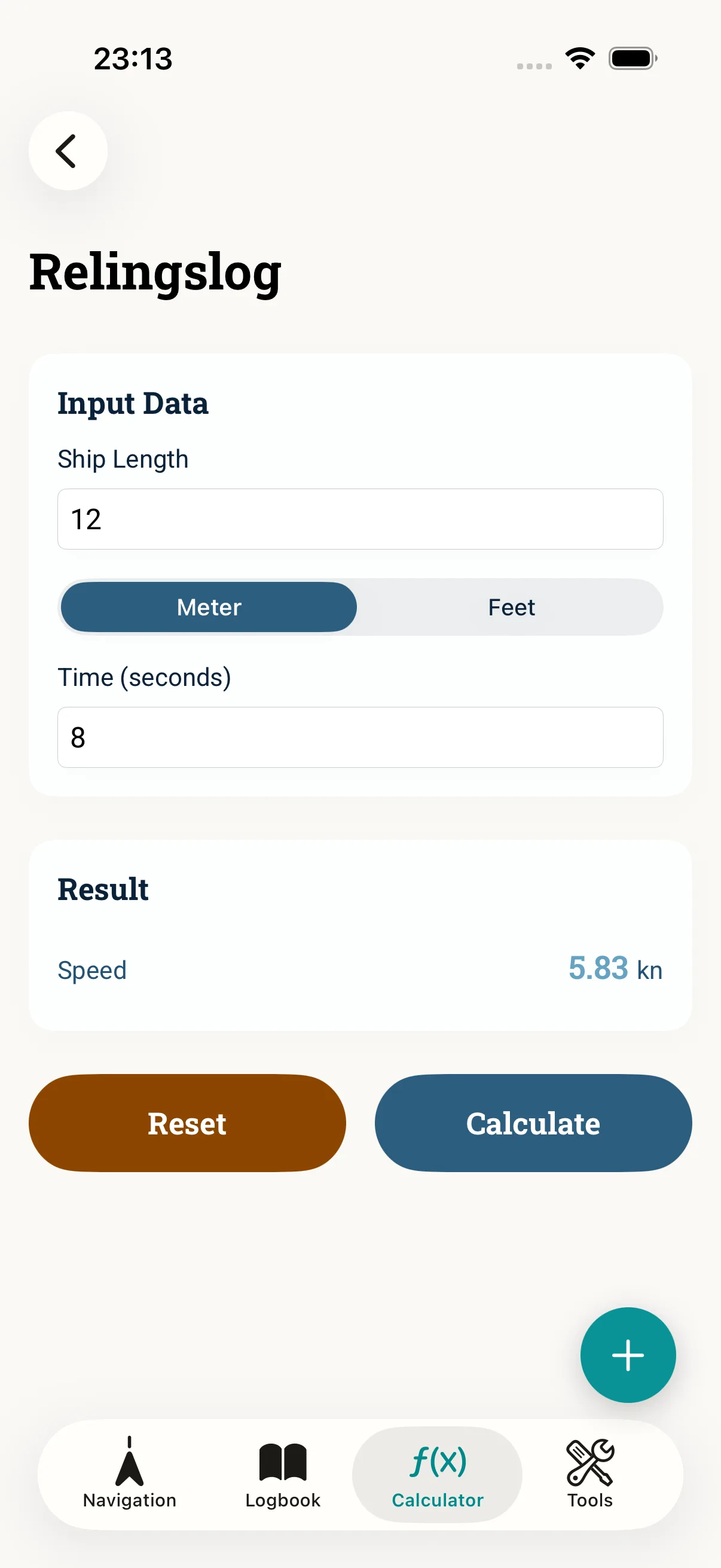
When there is no log transducer on the hull, or it has fouled over, you can still measure your speed through the water — the classic way, with the hull speed log (Dutchman’s log). The principle is as old as it is simple: you measure how long a floating object takes to travel the known length of the boat.
How it works
- You throw a piece of flotsam into the water forward (or use a fixed reference point in the water).
- You time how long it takes to pass the same rail aft.
- From boat length ÷ time comes the speed — converted into knots.
A 12 m boat where the flotsam runs from bow to stern in 4 seconds makes about 5.8 kn. The Hull speed log does the conversion for you, explained step by step in the Guide: Hull speed log.
Speed through the water, not over ground
Important: the hull speed log measures speed through the water (movement relative to the water surface) — not speed over ground. When current sets, the two differ. You need exactly this distinction for course correction and for a clean ETA: the sailing calculation depends on speed through the water, the actual arrival on speed over ground.
Cross-check against GPS
GPS conveniently gives you speed over ground. The hull speed log is still valuable:
- as a plausibility check when you want to see the difference between speed through the water and over ground (= current influence),
- as a backup when the electronics or the log fail. Just as NauticCalc reckons offline otherwise, the hull speed log works without any signal at all.
Common mistakes
- Measuring distance too short: on small boats the time gets very short — measure several times and average.
- Confusing speed through the water and over ground, especially in strong current.
- Flotsam too close to the hull, where the bow wave speeds it up.
- Measuring only once instead of averaging.
Conclusion
The hull speed log is hands-on navigation craft: boat length divided by time gives the speed through the water — independent of electronics. As a backup and a cross-check against GPS it belongs in every toolbox, precisely because it makes the difference between speed through the water and over ground visible.
Read more: Hull speed log · ETA calculator · Offline at sea