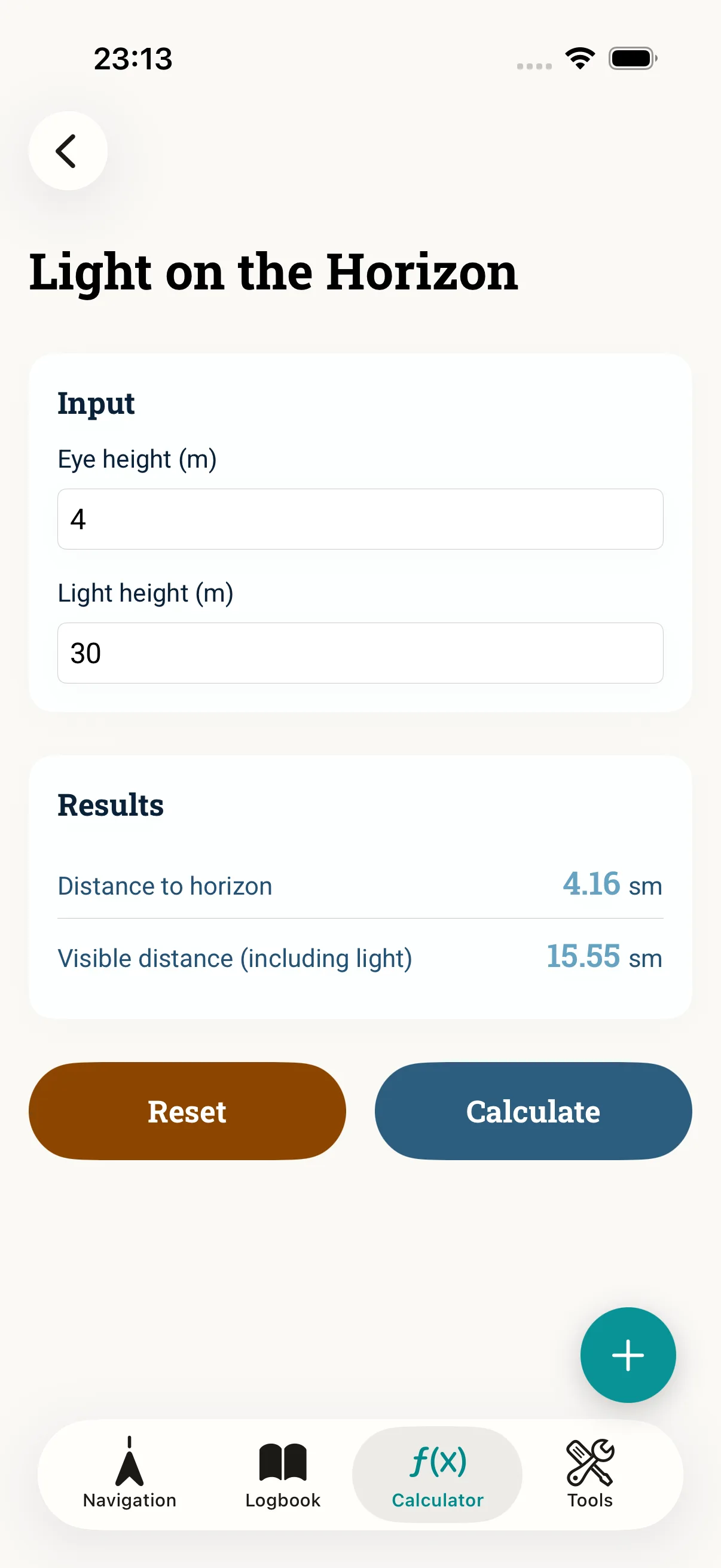
“Light on the horizon” — what it means
When a lighthouse appears on the horizon at night, the sailor says the light stands on the horizon. The horizon here is the visible sea-line. The moment a light rises above it reveals a fairly precise distance — provided you know two heights.
Geographic range
The geographic range depends solely on the curvature of the earth and two heights:
- your height of eye above the water (on a yacht often only 2–3 m),
- the height of the light of the lighthouse above chart datum.
Together they give the distance at which the light geometrically just appears. The higher the eye and the light, the further the view reaches over the horizon. You do not have to work the formula in your head — Light on the horizon does it for you, and the Guide: Calculate sight distance shows it step by step.
Geographic vs. nominal range
The key point is the difference between two kinds of “range”:
- Geographic range: purely geometric, determined by the heights (see above).
- Nominal range: how far the light is bright enough to be seen, at a defined standard visibility. It is listed in the light list and on the chart.
A light becomes visible only when both conditions are met: it must stand above the horizon and be bright enough. On a clear night geography is usually the limit; in haze it is the luminous range.
What it is good for
- Position fixing: the moment the light rises gives a distance to it — combined with the bearing, a line of position.
- Planning landfall: you know when to expect the light — and grow suspicious if it comes too early or too late.
- Plausibility: a cross-check against the GPS position, should the electronics play up.
Common mistakes
- Nominal range confused with geographic range.
- Height of eye set too high (a yacht is not a freighter).
- Tidal height forgotten: the height of the light refers to chart datum, your eye to the current water level.
- Haze ignored, which sharply reduces the luminous range.
Conclusion
“Light on the horizon” is more than romance: the moment a lighthouse rises is a measurable distance. Whoever keeps geographic range and nominal range apart and reckons with the right heights gains a clean line of position — entirely without electronics.
Read more: Light on the horizon · GPS position · Offline at sea