What a polar diagram is
A polar diagram — the polar for short — is your boat's speed table. It answers a single question, but for every combination of wind and course: how fast does this boat go in this wind strength at this angle to the wind?
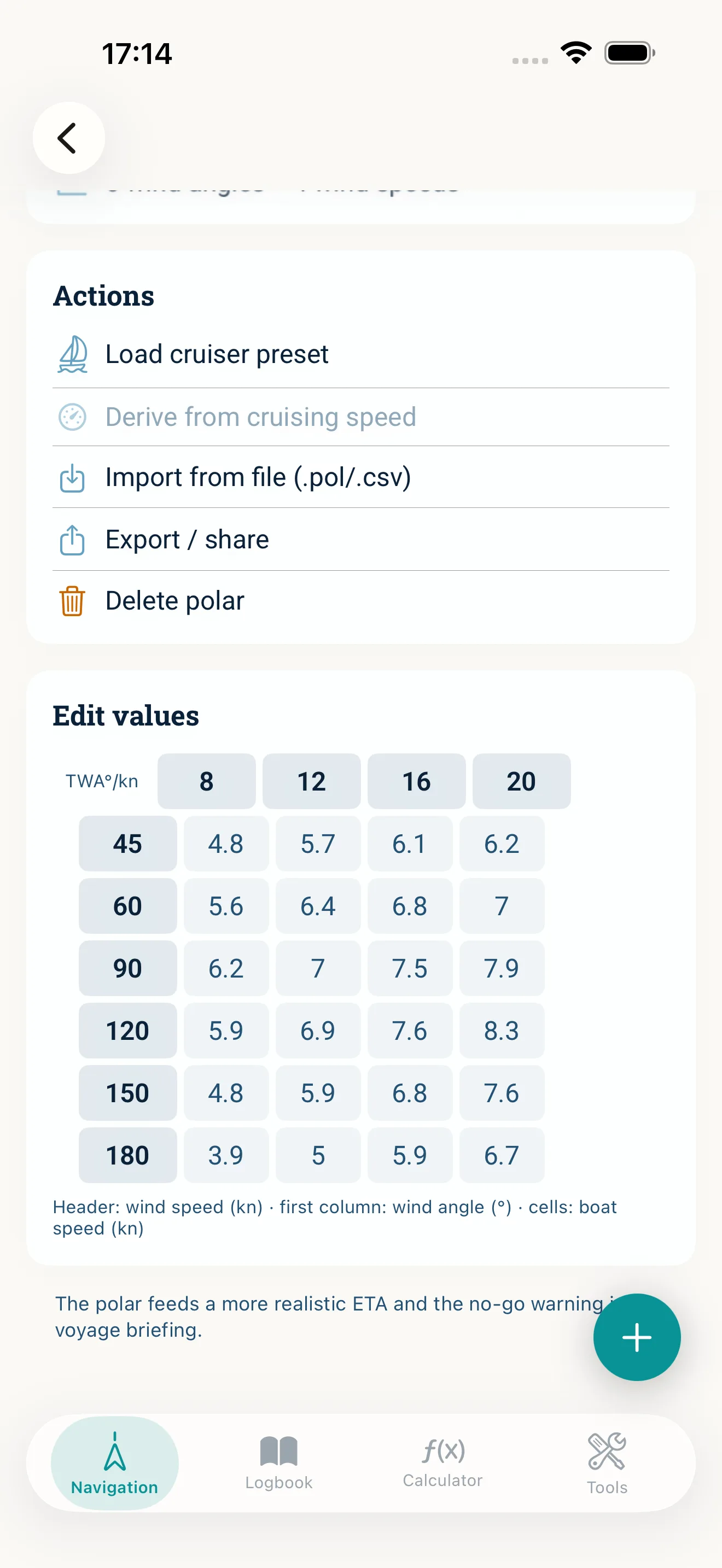
It is laid out as a grid:
- Header row: true wind speed (TWS) in knots — say 8, 12, 16, 20
- First column: true wind angle (TWA) in degrees — say 45°, 60°, 90°, 120°, 150°, 180°
- In the cells: boat speed in knots
One cell then reads: in 12 knots of true wind at 90° to the wind, the boat makes 7.0 knots. Plot the same values as a curve around a circle and you get the characteristic shape the polar is named after — pinched close-hauled, bulging on a reach.
Why a single cruising speed is not enough
Most voyage plans work with one number: five knots, six knots, whatever the boat "usually does". That number is right for no course at all.
- Close-hauled a cruising boat is considerably slower than its cruising speed — and the closer the course comes to the wind, the harder the speed falls away.
- On a beam reach in fresh wind the same boat is noticeably faster.
- Dead downwind it loses again, because boat speed takes the apparent wind away.
- In the no-go zone it does not go at all — the speed is zero there and the course has to be worked to windward.
A flat cruising figure averages across all of that. On a short hop you hardly notice. On a 40-mile day it quickly becomes an hour out — and that hour decides whether you arrive in daylight or go looking for the harbour light.
Where to get your polar
- From the designer or class association. Published polars exist for many production yachts.
- From rating data. ORC certificates contain calculated speeds across angle and wind strength.
- From racing software. Polars usually live there as a
.polfile, occasionally as.csv. - From your own records. Collect logbook values over a season — wind, angle, speed through water — and you can fill the table yourself. That is the most honest version, because it reflects your hull with your sail wardrobe and your fouling.
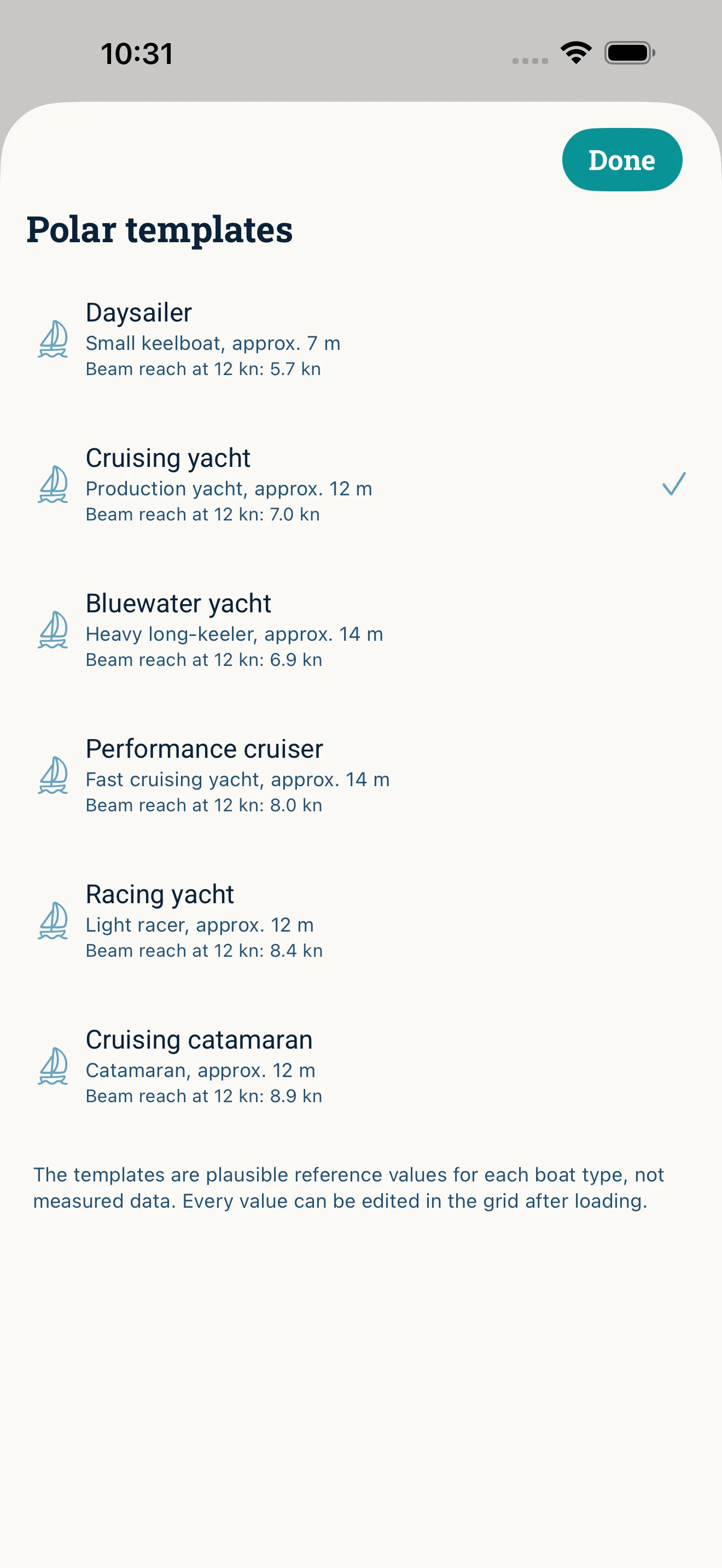
- From the template library. Six templates from daysailer to cruising catamaran cover the common boat types — take the one closest to your boat and fine-tune the values afterwards.
- As an approximation. With none of the above, a polar derived from your cruising speed still beats one fixed number: the shape is roughly right, only the height is a guess.
What the app does with it
In NauticCalc you store the polar once in the boat profile. From then on it feeds three places in voyage planning:
- The arrival time uses, for each leg, the speed that belongs to the wind strength and the wind angle — interpolated between the grid values.
- The no-go warning speaks up when the course lies too close to the wind. Instead of an ETA you could not hold under sail, you get told that you will have to beat or motor.
- The beating and gybing plan works out both tack headings, the extra distance over the direct route and the sailing time — and drops the turning point into your route as a waypoint if you want it.
Common mistakes
- Using racing polars for cruising. They assume flat water, a clean hull and a crew trimming constantly. Under cruising conditions the real numbers sit below them.
- Mixing up true and apparent wind. A polar works with the true wind. Enter instrument values (apparent) and the whole table shifts.
- Forgetting the sea state. A polar applies to smooth water. In a steep sea it no longer holds upwind — plan reserve there.
- Too coarse a grid. Four wind strengths and six angles are plenty for planning. Two angles are too few, because the app then interpolates straight across the range that matters.
In short
A polar diagram turns a guessed arrival time into a calculated one. The effort is one-off — import a file or load a template — and the benefit rides along on every leg: an ETA that matches your boat, a warning before the course becomes unsailable, and a beating plan with the detour already worked in.
Read next: Polar diagram (feature) · Set up a polar (guide) · Voyage briefing